THE METHOD
Performance is designed
Most people try harder inside the same conditions.
Performance problems are rarely random. What looks like inconsistency or stalled growth is almost always a design issue. This is the method for finding the cause, redesigning around it, and embedding the result so it holds.

THE OPENING READ
The visible result is only the surface
Most organizations have a strategy document, but the strategy that operates in daily behavior and the strategy on paper are different documents. The gap between them is where most of the performance loss lives. The first work is to read both, name the gap precisely, and design the moves that close it.
This is the read that earns the work. When a leader recognizes their own organization in those sentences in the first five minutes, the work has begun. What follows is calibration.
THE METHOD
Three dimensions, deliberately aligned
Performance is the product of three dimensions running together: technique (what you do), mindset (how you respond), and environment (what surrounds the performance). Most systems develop one of the three and assume the other two will follow. They do not. High performance requires all three, deliberately aligned.
The leverage in this work is not in technique or mindset. Coaching and psychology have professionalized those — there are good people in both, and we work alongside them, not against them. The leverage is in the environment: the standards, the daily behavior, the feedback, the information flow, the physical surfaces, the way roles relate to each other. The environment is what was never designed. It is what we design.
HOW IT WORKS
Reset → Development → Embedding
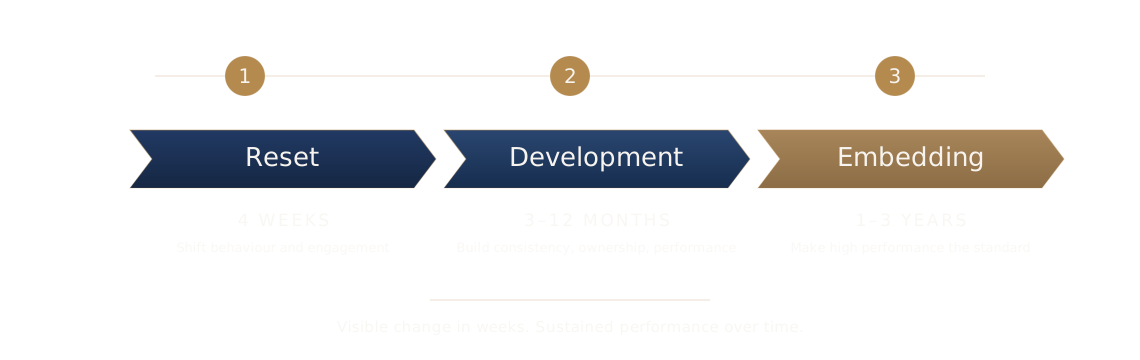

RESET · 4 WEEKS
Find the cause. Define the first moves.
Three reads happen in parallel. First, why the issue exists — not what people describe (usually the symptom), but the structural cause behind it. Second, the strategy and the destination — what the organization actually wants, and the gap between strategy on paper and strategy in behavior. Third, the first moves — the few things that, made in the right order, make the next phase possible.
The output is a written problem statement, a redesign brief, and the first moves. It is bookable, priced, and complete in itself. An organization can take the Reset and stop there — the four weeks will already have produced visible change. But its deeper job is to be the entry: it tells both sides whether the longer engagement is right.
DEVELOPMENT · 3–12 MONTHS
Redesign the structure. Build the team that owns it.
Three things happen in parallel. The structure is redesigned around the first moves — standards, feedback loops, role definitions, decision rights, communication patterns, whatever the Reset surfaced. The redesign is built with the organization, in their language, in their context, so they own it by the time the engagement ends.
A team is formed, built around the people who get the system and want to contribute — across levels and functions, not from the org chart. They become the working group that owns the redesign. Their commitment is what makes the new environment real; an environment owned only by the consultant is one that ends when the consultant leaves.
The team works across the dimensions: in organizations, six (people, process, applications, data, technology, physical environment); in sport, three (coach and team culture, athlete, parents). People are the essential element — the rest exists to make the work people do, do-able. The output is a system that runs, in the room it was built in. But it still depends on the engagement, which is what Embedding is for.
EMBEDDING · 1–3 YEARS
The team becomes the proof and the growth medium.
Embedding is the phase most engagements never reach, because most engagements end at Development. This is the phase that produces the durable result — the one a board can point to in three years and say the work paid for itself many times over.
The mechanism is specific. The team formed in Development becomes the visible example inside the organization. Their unit runs differently. Their results are different. Other parts of the organization see it. The system spreads not by directive but by demonstration. The team is the proof, and the team is the growth medium.
Our involvement drops to near zero. The roles inside the organisation take over. The designed environment continues to do its work without us. That is the exit condition — a system that sustains itself, with the organization’s own people running it. It is the only outcome that defines success.
THE STRUCTURE
Performance is produced by five roles
Most engagements fail because one or two of these are not in the conversation. The work is to align them through the designed environment.
The performer
Delivers performance inside the environment — athlete, contributor, team member. Their performance is what is measured; they are not the unit of analysis.
The direct leader
Coach, team lead, manager. Translates the environment into individual experience day to day. The role most often blamed when the structure is what is broken.
The system owner
Strategic (CEO, board, athletic director), operational (COO), financial (CFO), structural (CIO, CTO). The owner’s authority is required to commission the work and protect it long enough for Embedding to land.
The support environment
Parents in sport, team dynamics in organizations, the culture surrounding the performer. The role most often unnamed — and the one that most often goes wrong unaddressed.
The designed environment
The structure of expectations, feedback, incentives, and interaction patterns. It is what we build. The other four roles operate inside it.
Performance problems are never the property of one role. They emerge from misalignment between them — the performer doing what the direct leader signals, the direct leader doing what the system owner has structured, the system owner unaware of what the support environment is doing. We work the misalignment.
WHERE IT APPLIES
The method doesn't change. The room does.
Three rooms. One method, translated to each. The dimensions, the language, and the buyer differ; the structural lens does not.
Olympic Architecture
Strategic Transformation and Performance Architecture — for leaders who need performance, not frameworks.
PhenoManon
The method translated to clubs and teams, with the Athlete Experience System as the working surface.
The Unexpected Olympian
The method delivered in a single session — keynotes and workshops for leadership teams and conferences.
Olympic gold and silver; sport systems that outlast the engagement; organizational transformations across three enterprises — the same method, in three rungs of the same ladder
HOW ENGAGEMENT WORKS
The Reset is bookable. The rest is scoped in conversation.
The Reset is a fixed-scope four-week engagement with a clear deliverable. It can be bought without a conversation — concrete, priced, time-bound, complete in itself. It is the natural front door, and for many organizations it is enough on its own.
The longer engagement (Development, Embedding) is not a product. It is bespoke by definition — the redesign is specific to the cause and the gap surfaced in Reset, and the timeline depends on the organization’s appetite. It is scoped in conversation, after a Reset or after a discovery call has established whether the fit is real.
The discovery call is the front edge of the work, not a sales call. It is the first version of assess why, read the gap, define the first moves, run in 30–60 minutes against a single situation. It demonstrates the method by doing it. The valid outcomes are three: book a Reset, scope a longer engagement, or agree that this is not the fit. All three are honest.
Most engagements start with a four-week Reset.